

Have you ever wondered how common your pet’s surgery is?
Here are our 10 most common surgeries at LRVSS in 2025:
1. ACL surgery
Year after year, we perform a huge number of TPLOs (Tibial Plateau Leveling Osteotomy) to address a torn ACL in dogs.
It is typically performed in heavier patients (say 40 lbs and over).
But thinking TPLO is only for big dogs would be a misconception.
The most important factor to choose the best surgery option is to measure an angle at the top of the shin bone.
If the angle is very small, we can use heavy nylon sutures to “replace” the torn ACL.
And if the angle is too steep, then even a TPLO is not ideal.
Patients (of any size) with a very steep angle need a TWO (Tibial Wedge Osteotomy) or CWO (Closing Wedge Osteotomy).
Matching the surgery to the patient’s need is how we get repeatable, predictable, good to great results.
2. Mass removal
We have removed lumps and bumps from virtually every body part last year: under the skin (legs, chest, neck, etc.), near the anus, inside the rectum, in the anal sac, in the intestine, in the armpit, in the throat, in a lung, etc.
Many masses were malignant (aka cancerous), and some were benign.
3. Fractures
Our most common fracture last year involved the radius (in the forearm) and the tibia (aka shin bone).
We also repaired multiple fractures in other bones, most often after cats and dogs were hit by a car, or jumped from their owner’s arms or off the couch.
Some fractures required pins, most needed a plate and screws.
Below are before and after pictures of a tibia (shin bone) fracture, repaired with a plate and screws.

4. Kneecap dislocations
The kneecap is designed to slide up and down in a deep groove at the bottom of the thigh bone (or femur).
When the kneecap pops in and out, it damages the cartilage and leads to arthritis and pain.
It is common in dogs, and we’ve seen a few kitties with that condition.
A dislocated kneecap can sometimes lead to a torn ACL – a double whammy.
5. Belly surgery
Belly surgery (aka exploratory laparotomy) is performed for multiple reasons:
- removing body parts (e.g. a tumor in the spleen or the liver, a tumor in the kidney, a hopelessly distended colon – megacolon in a kitty)
- taking biopsies
- removing bladder stones
- removing foreign bodies, etc.
6. Hip surgery
The hip is a “ball and socket” joint.
When the ball is dislocated or fractured, a common procedure is to remove the “ball”, aka the femoral head, during a surgery called a Femoral Head Ostectomy (FHO)
FHO is also done in small dogs with hip dysplasia or because of deterioration of the “ball” (Legg Perthes disease).
Intensive physical therapy is critical to get good results after an FHO.
7. Hopeless ear infections
The TECA (Total Ear Canal Ablation) is a procedure to treat tumors or end-stage ear infections
Cats and dogs with ongoing ear infections are typically treated with countless antibiotics, sometimes for years.
In some cases, antibiotics stop working, and the best solution is a TECA, which can dramatically improve the patient’s quality of life.
8. Amputations
Leg amputation is most commonly needed because of cancer in the leg – most often bone cancer.
Occasionally, it is done because of severe trauma or fractures.
Thankfully, cats and dogs do well after an amputation, we see it all the time…
9. Laryngeal paralysis & “BOAS” surgery
Upper airway surgery was also very common in 2025.
- Dogs, most commonly Labs, can get a condition that paralyzes their larynx, or voice box.
It’s a very stressful condition.
Tie-back surgery allows them to have a wider airway, which can dramatically improve their quality of life.
These patients quickly go from suffocating… to being able to breathe comfortably.
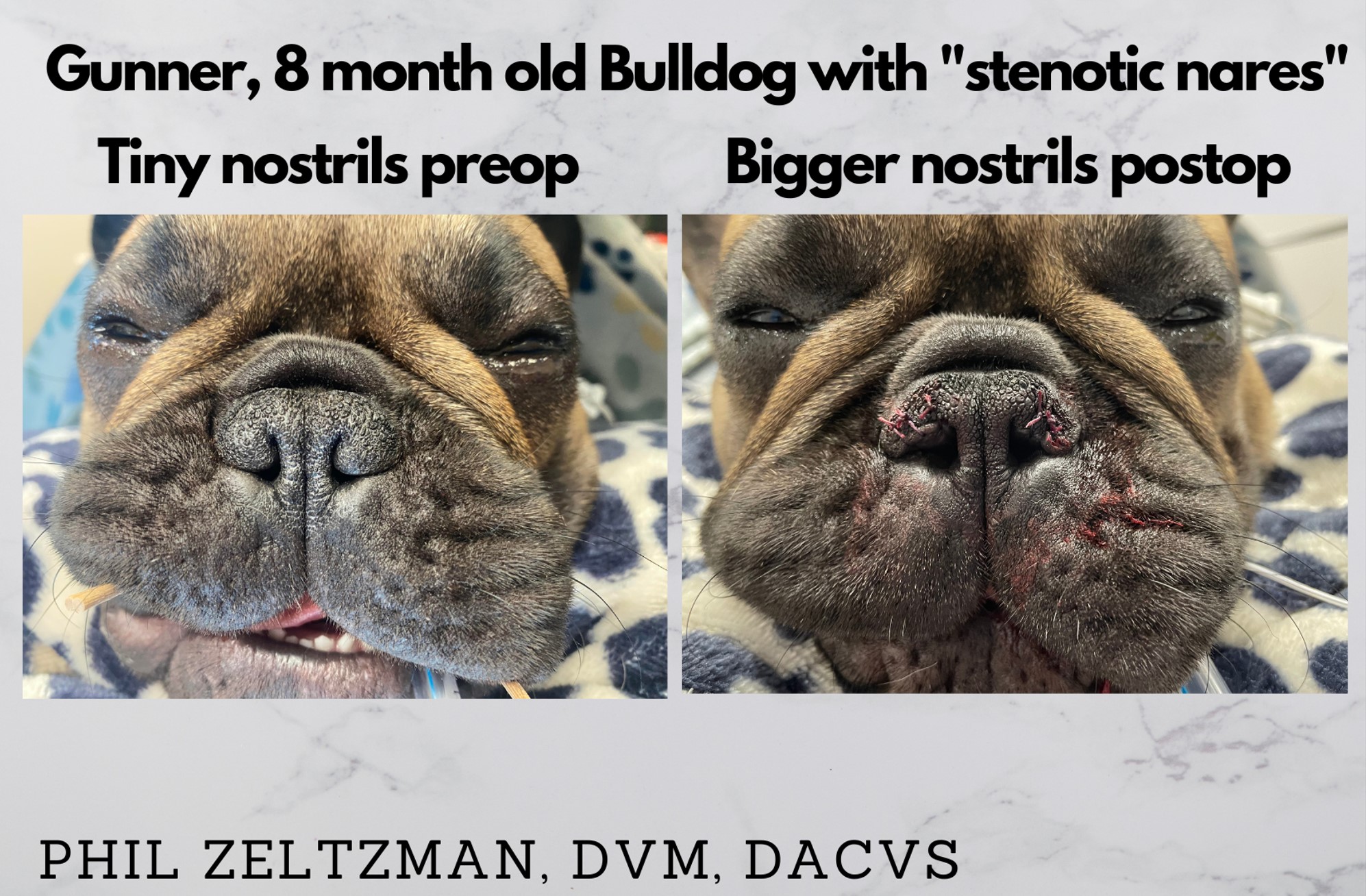
. Dogs (and cats) with a flat face struggle to breathe by day, and snore at night, because of several conditions, starting by their tiny nostrils.
These patients, called brachycephalics, have a condition call BOAS (Brachycephalic Obstructive Airway Syndrome).
There are 2 or 3 main steps during surgery:
- Step 1: a “nose job,” designed to widen the nostrils (see before and after pictures below).
- Step 2: surgery to shorten the elongated soft palate and…
- Step 3: … if needed, surgery to remove 2 fleshy parts in the throat (everted laryngeal saccules).
10. Joint injections for arthritis
The biggest revelation of 2025 is how commonly we now treat arthritis with several drugs and products.
They can be injected directly into the painful joint (under sedation!).
The most common options are:
- long-acting cortisone
- hyaluronic acid (“HA”), a natural lubricant in the joint
- Spryng, a natural product mostly made of collagen.
We can combine those drugs and product depending on the patient’s needs.
If your pet had surgery, you may now realize how common that surgery is.
This year-end review is a tribute to our referring vets, our clients, our patients, and our amazing nurses.
And it’s a tribute to our referring vets, our clients, our patients, and our amazing nurses.
Here’s to a wonderful & healthy New Year to you, your family and your pets.
If you would like to learn how we can help your pet with safe surgery and anesthesia, please contact us through www.LRVSS.com
Never miss a blog by subscribing here: www.LRVSS.com/blog
Phil Zeltzman, DVM, DACVS, CVJ, Fear Free Certified
Pete Baia, DVM, MS, DACVS