
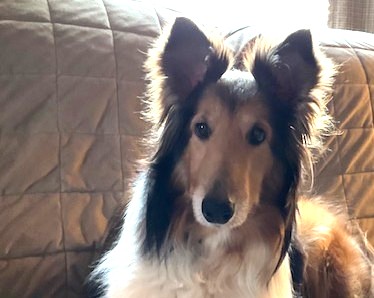
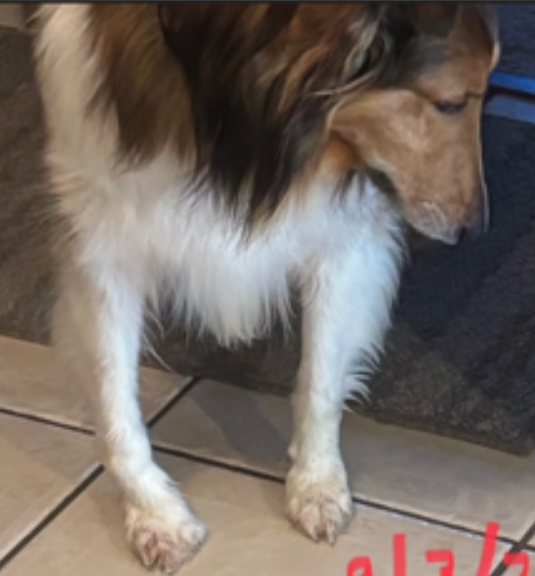
Scout, a sweet 8 year old Sheltie, had a bizarre deformity of his right wrist.
It wasn’t just cosmetic.
He went from a “very active dog, playing catch in the backyard pretty much every day of the year” to “not running at all.”
Out of the blue, the wrist started to swell and turn inward.
Scout’s owner is incredibly dedicated, so she tried “everything” to help her beloved pup!
. X-rays were taken by Scout’s family vet. They didn’t show much.
. Librela, an anti-arthritis medication, was prescribed. Whether it made things better or worse is still up for debate…
. A CT scan was performed “elsewhere”. It didn’t show much.
. An Assisi Loop was recommended. “A waste of money” according to Scout’s owner.
. “Heat therapy” was then suggested. “Zero improvement” was noticed.
. A custom-made brace was then recommended. It did nothing.
. A consultation with another surgeon led to this comment: “This is unusual and beyond the scope of surgery.”
Meanwhile, the wrist kept getting more and more crooked…
A glimmer of hope
About 6 frustrating months later, Scout’s owner (aka Sherlock Holmes) found LRVSS where we met for a consultation.
After scratching our heads, the solution suddenly seemed obvious.
We had several goals in mind:
- Make Scout comfortable
- Stop the progression of the crooked & swollen wrist
- Improve his quality of life and allow him to run and play ball again.
Our solution?
A procedure called an arthrodesis, which means fusing the wrist in a fixed position.
Sherlock, sorry, Scout’s owner, recalls: “I’m one of those people who does a lot of research. You had stellar reviews from not just 3 or 4 owners, but many, so I had confidence in you before we met.”
Scout gets a pancarpal arthrodesis
That’s the name of the surgery.
Arthrodesis means fusing a joint.
The carpus is the medical term for the wrist.
Carpal is the adjective.
Pan-carpal meant we fused the entire wrist.
The steps of the surgery are the following:
. removing the cartilage between the small joints of the wrist to allow
. filling the gaps with a bone graft to speed up healing
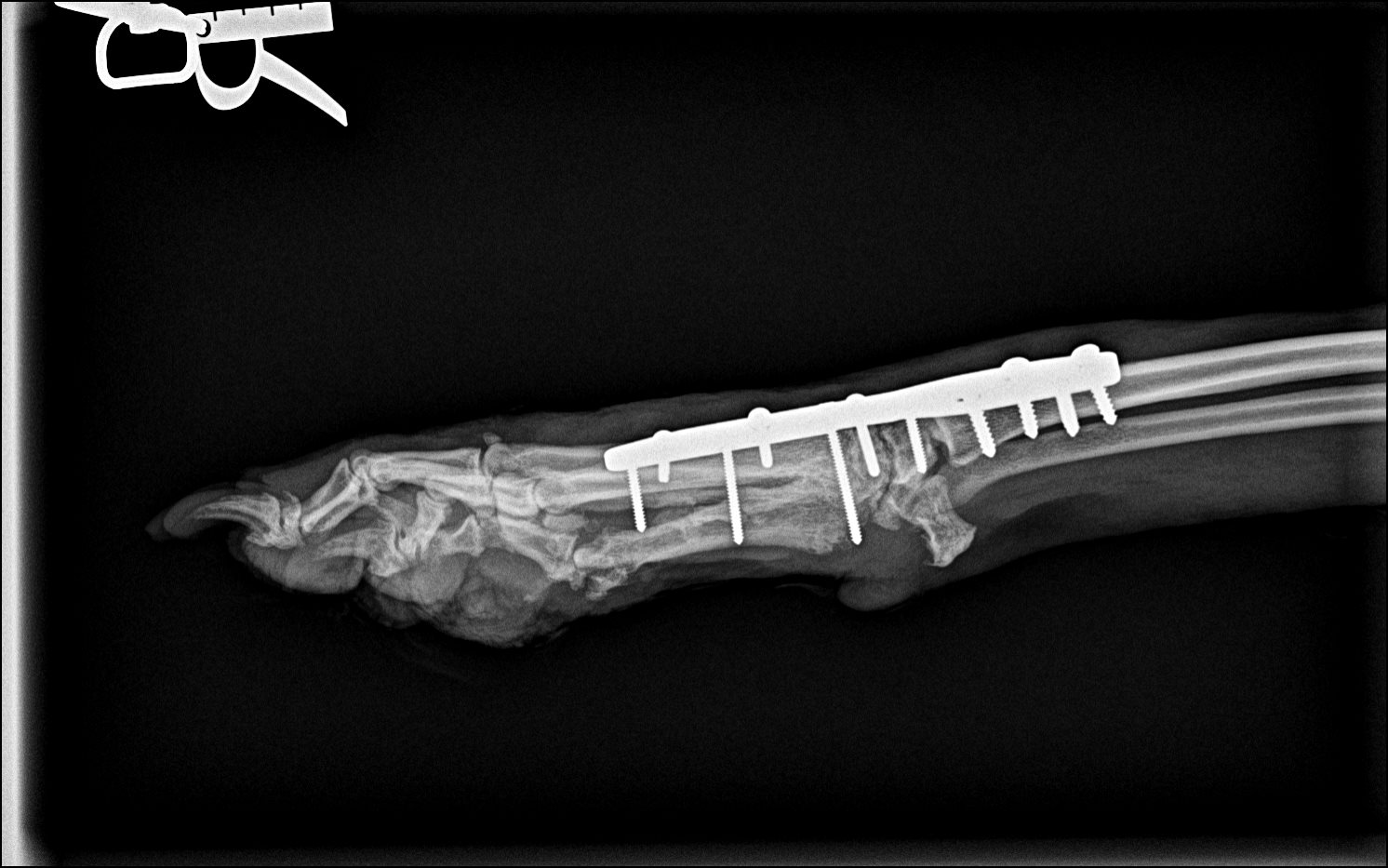
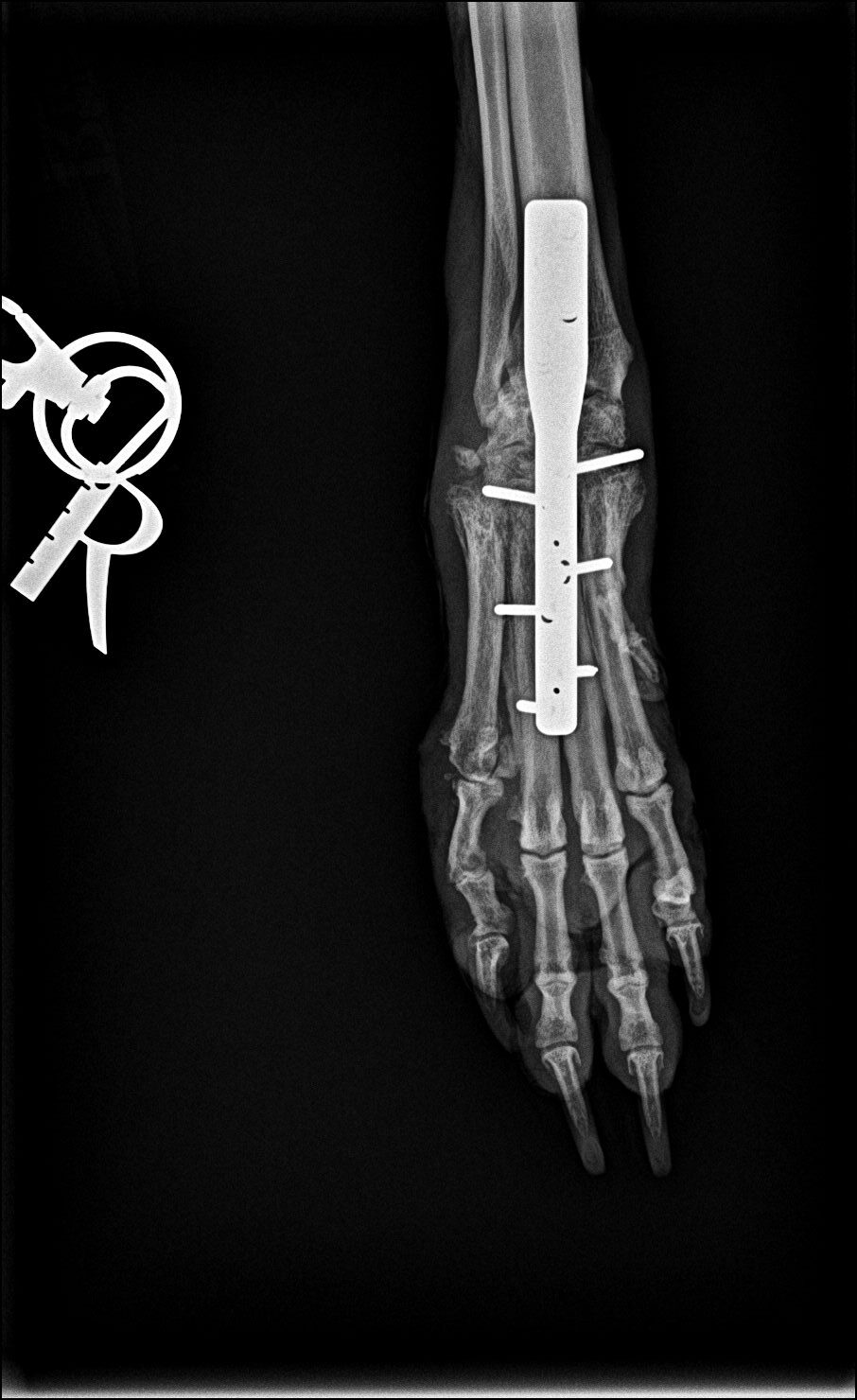
. Using a plate and screws to fuse the joint.
Postop X-ray From The Side
To protect the repair, we then placed a splint, which had to be changed regularly.
Postop X-ray From The Front
After one night in ICU on IV fluids, antibiotics and pain medication, Scout went home the days after surgery.
Scout’s Leg is Nice and Straight After Surgery
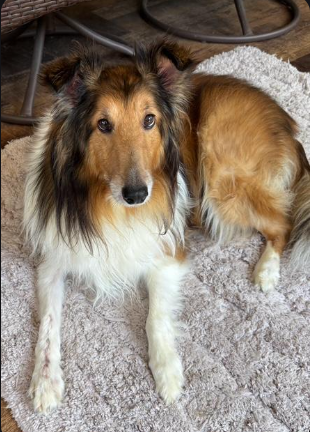
Scout’s owner commented: “Scout had to stay overnight due to his invasive surgery and we were so thankful he was under a watchful medically trained eye all night!!! That really provided serious peace of mind. Then the detailed info on his postop meds and bandaging schedule was laid out clearly, verbally and in writing, so there were no questions on the process.”
Here is a short video that summarizes Scout’s adventures.
How is Scout doing 1 year after surgery?
He’s been fantastic. His surgery leg looks better than his other leg! You wouldn’t even know he had leg surgery.”
That’s pretty much the best compliment a surgeon can hear!
In addition:
“We couldn’t have been more pleased with the process and the outcome for our Scout.
You and your team were so kind, helpful, and understanding, that it made a stressful situation much better than we felt we could have realistically hoped for.”
If you would like to learn how we can help your pet with safe surgery and anesthesia, please contact us through www.LRVSS.com
Never miss a blog by subscribing here: www.LRVSS.com/blog
Phil Zeltzman, DVM, DACVS, CVJ, Fear Free Certified
Pete Baia, DVM, MS, DACVS